A week or two ago, I asked a friend when I could expect to see another My Morning Jacket album. She said it will be awhile since the lead singer Jim James is busy with his other project, Monsters of Folk.
After giving their album a listen, Wow!, what a project it is. Although there is “folk” in their name, iTunes classifies it as “country” and allmusic.com claims it is “squarely in the “classic rock” camp.” In other words, there is some cross-over likability here.
I will have a tough time picking just one song of this solid album for my year-end favorites mix come December .“Whole Lotta Losin” comes on like a Traveling Wilburys mover. “Sandman, The Brakeman And Me” is a bit slower, but down-right perfect. With the production and James on lead vocals, “Losin Yo Head” has a MMJ feel to it -- just what I have been missing. “The Right Place” has the country-twinge of 70’s rock. And “His Master’s Voice” reminds me why I was so captivated by the power of simplicity captured on The Cowboy Junkies’ breakthrough album The Trinity Sessions so many years ago.
Most of the stuff I like and listen to does not have the wide appeal this does. In other words, get it. You won’t be disappointed.
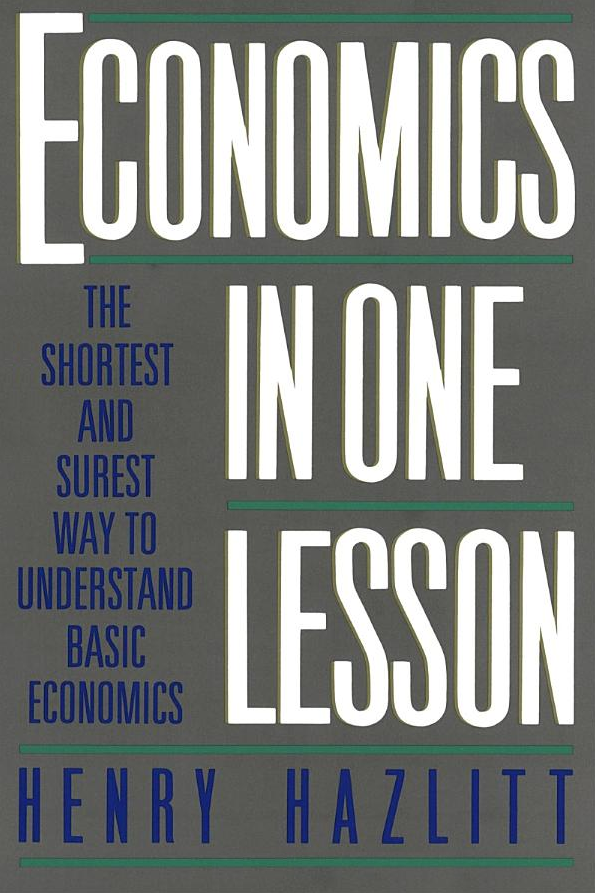
The lesson of Henry Hazlitt’s book Economics in One Lesson: The Shortest and Surest Way to Understand Basic Economics is based on the premise of unintended consequences, or more precisely, that “The art of economics consists in looking not merely at the immediate but at the longer effects of any act or policy; it consists in tracing the consequences of that policy not merely for one group but for all groups.” In other words, economic policies are driven by a desire to “help” one group while ignoring the effects those actions have on all other groups.
The first chapter explains the lesson. The remaining chapters apply them to potential policies.
In this age of economic uncertainty, this 60-plus year old book remains relevant. Take, for instance, this snippet. It is impossible to do so without thinking about the trillions of tax dollars our government has dumped into poorly run businesses like GM and AIG and squandered "stimulating" industries in general:
“It follows that it is just as essential for the health of a dynamic economy that dying industries should be allowed to die as that growing industries should be allowed to grow. For the dying industries absorb labor and capital that should be released for the growing industries. It is only the much vilified price system that solves the enormously complicated problem of deciding precisely how much of tens of thousands of different commodities and services should be produced in relation to each other. These otherwise bewildering equations are solved quasi-automatically by the system of prices, profits and costs. They are solved by this system incomparably better than any group of bureaucrats could solve them. For they are solved by a system under which each consumer makes his own demand and casts a fresh vote, or a dozen fresh votes, every day; whereas bureaucrats would try to solve it by having made for the consumers, not what the consumers themselves wanted, but what the bureaucrats decided was good for them.”
This book is short -- only a couple of hundred pages -- and simple to understand. It should be required ready for every high school student. Nix that. It should be required reading for every American. In fact, the world would be a better place if every politician read this book before ever considering any legislation, economic or otherwise.
There were so many take-aways from the book, that it is impossible to list them all here. In fact, if you are interested in researching it, I recommend purchasing the audio version so you can continually revisit it. I am constantly reviewing it and pick up something new from it every time that I do.
One of Taleb’s greatest insights is the recognition that people tend to believe in what is convenient, not what is necessarily true. We adopt things that confirm our biases and ignore those that contradict them. People believe what they want to be true, trivializing and ignoring every fact that does not fit that paradigm. As humans, we have an incredible capacity to deceive ourselves. It is how we comfort ourselves from the very random and scary world in which we live. Likewise, we tend to argue to be right, not to discover truth.
Recognizing this has changed my entire world view. It has opened me up to constant change. I now recognize that I know much less than I think I do. It is very humbling. The evolution of my political beliefs are a great example.
Political labels are dangerous. Everyone tends to have a different definition for them. But by my own definitions, over the years I have gone from a hard-core left of left liberal (while in a political argument with my father during my college days, he once called me a “communist”), to a mainstream Democrat, to a paleo-conservative independent, to a Libertarian. But that is not where it ends. Last week, I recognized another evolution in my thinking.
I immediately recognized we have a similar thought process. (I may be a bit more light-hearted, though. I doubt you will ever find music reviews, guest blogs or favorite recipes on his blog.) As Papola states: “I’m blogging as a way to work out my thoughts and hopefully get useful criticism that will help me be a better thinker and a more open person. Much of my reading and writing is about economics, but I ultimately believe that ethics are the core of any social discussion. So this really is a philosophic and educational exercise.”
That brings me back to Taleb and my search for truth. Because I like to “engage” in discussion rather than “argue” politics, I am adopting Papola’s political “label”. Although I remain a registered Libertarian, I would now call myself a Classical Liberal. As Papola states: “I generally prefer “Classical Liberal” as a label since it provokes questions and lacks the baggage of “conservative” or even “libertarian” in some ways.... for now. I’m open to change as I learn and grow. I simply ask that you, the reader, not ascribe to me any ideas that I haven’t put out there directly. Guilt by association is lame hackery.”
So as I also continue to “work out my thoughts” on this blog, remember, if we are discussing politics, I am not here to “argue”. Engage me, but be prepared to carry out your thoughts to their logical conclusions. Also be prepared to recognize that the way you want the world to be may not be the way the world really works. I am here to learn and discover through inquiry and skepticism what truths I can stumble upon. In doing so, I am prepared to be wrong. I hope you are, too.
This week I had this fun project to assemble. One of my Art Directors needed an image with assorted fruit and vegetables for an article on eating healthy. After gathering assorted stock images, here were her instructions:
• Take out apple or apples to the left. • Add peaches to replace apples. If some apples stay, and you just change their texture, I’ve provided you with an image of the top of a peach. • Add to background on left (textured wood background). • Add to carrot stalks. I’ve added a couple carrot images to the folder if that’s helpful. • Add green beans. Please play with images to make them appear as natural as possible. • Take out ultrasound image.
My girlfriend gave me a Pampered Chef 7” Santoku knife for my birthday, so I asked her to pick something for me to cook so I could do some chopping. She knows I like stuffed peppers, so she searched for some recipes online to “guide” me and I re-engineered them to come up with my own variation. Since it turned out better than most of my experiments, I figured I would share it here:
INGREDIENTS: 1/3 cup jasmine rice 2 tablespoons olive oil 1/4 cup minced carrots 1/4 cup celery 3 bell peppers (in my case: two green, one red) 1/4 pound ground beef 1/3 pound pancetta 3/4 cups marinara sauce (I include my home-made version here) 1/8 cup red wine 1/4 teaspoon red pepper flakes 1/4 cup whole milk 1/4 cup grated Parmesan cheese 3 slices American cheese
DIRECTIONS: 1. Prepare marinara sauce: Saute a quarter cup chopped onion and one large chopped clove of garlic. Add one cup of fresh peeled tomatoes slightly pureed, one quarter cup of fresh chopped basil, a pinch of parsley and simmer until it reduces down to a relatively thick sauce, about twenty minutes. 2. Cook rice. I use a rice cooker so I don’t have to baby sit it. 3. Then, get started on your stuffing mixture: Heat 1 tablespoon of oil in a large skillet over medium high heat. Saute carrots and celery. Add pancetta, then ground beef, cook until browned and crumbled; drain off any excess liquid, and return to heat. Add marinara sauce, wine, and red pepper flakes. Stir in rice. Add cream and half of the Parmesan cheese. Simmer a few minutes more, allowing for most of the liquid to reduce. 4. Preheat oven to 375 degrees F. 5. Par boil Peppers for two minutes. Remove and rinse in cool water to stop them from over-cooking. Place peppers in a shallow baking dish, and fill with stuffing mix. 6. Bake, uncovered, for 30 minutes in the preheated oven. Remove from oven at about 25 minutes and cover peppers with American cheese, sprinkling remaining Parmesan on top. Bake five more minutes or until cheese starts to brown. 7. Serve hot, preferably with a couple of cold Sierra Pale Ales.
Next time I think I will use Brother Jim’s suggestion and try grilling them...
I love books that not only expand what I know but also challenge what I believe. Lies My Teacher Told Me does just that. I suspect my political and economical views differ greatly with the author’s, but in this great book, James W. Loewen presents a case against the textbooks currently used in our high schools that goes far beyond ideology.
As I discuss in this blog frequently, people tend to believe in what is convenient, not what is true. Well, as someone formally trained as a high school history teacher, I have to admit it seems we also teach that way as well.
Our collective-minded education system presents American history to our children as a mindless series of over-simplified white-washed myths conveniently excluding any information that seemingly denigrates or contradicts the larger-than-life propaganda that textbooks tend to perpetuate.
Amongst many other valid observations, Loewen explains that by presenting American history as a series of endlessly boring preordained facts, students don’t see the conflict of ideas, the evolution of thought or the alternatives that could have come into being.
For instance, one example the author uses is the treatment of Columbus. Columbus did not “discover” America. Obviously, Native Americans were here first, but evidence also points to the likelihood that Asians, Norse, Phoenicians and even West Africans set foot in the Western Hemisphere long before Columbus arrived. The author goes beyond pointing out the obvious ethnocentric influence of our education system. The notion that the “winners” write the history, after all, is nothing new.
Also contrary to popular myth, Columbus was not an altruist voyager looking to discover new worlds for the betterment of mankind. He was driven by the same thing we all are. He sought greater wealth. His search for gold made him an intolerant racist tyrant and he used his religious piety to justify raping, murdering and enslaving thousands of Native Americans.
The author points out that these facts do not condemn Columbus in their own-right. He was not the “original” slave-trader, after all. What complicates the story is that Native American and African cultures were already dealing in slaves themselves. Like all of us, Columbus was a product of the times he lived in. Rather than hero-ize him or vilify him, he should be presented with all the facts, allowing student to see him for who he really was, accomplishments, warts and all. Students -- and you and I -- should be allowed to make and discuss our own conclusions.
This is the whole point. History is complicated. It is not as clean and politically correct as our indoctrination machines would like it to be. While simplifying it and “cleaning” it up may be easier than dealing with it honestly, unfortunately, for most high school students this also makes it instinctively untrustworthy and unchallenging as well.
My main qualm with the book is it’s sub-title: “Everything Your American History Textbook Got Wrong”. While the premise of the book is right on, the book contains “examples” of inaccuracies. “Everything” would require an encyclopedia-sized collection of volumes in order to even begin scratching the surface. And although some readers may have problems with the author’s obvious liberal-bent, the facts he presents are undeniably eye-opening and discussion-worthy regardless of one’s own perspective.
This book provides a great starting point for a discussion of what and how we teach and learn American history.




 Posts


